
For years, the vision of the fully autonomous, “lights-out” warehouse has captured the imagination of supply chain leaders. In theory, robotics and artificial intelligence would eliminate the need for human labor, creating highly efficient operations that run continuously with minimal intervention.
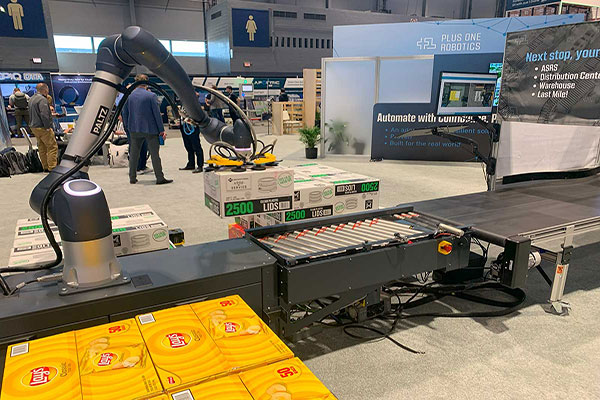
In practice, that vision remains out of reach for most organizations, though. The reason, according to Erik Nieves, CEO of Plus One Robotics, is straightforward: modern supply chains are too complex and too variable for fully autonomous systems to handle on their own.
“In an actual supply chain constraint, variability is the rule, not the exception,” he told Supply Chain Management Review in a recent interview.
The challenge of variability
Traditional industrial robotics has long succeeded in structured environments, particularly in manufacturing settings where processes are predictable and inputs are consistent. But warehouse and distribution environments operate differently. Products vary in size, shape, packaging, and condition, and nowhere is that more evident than in e-commerce and parcel operations where returns and mixed inventory streams introduce additional complexity.
Variability creates a fundamental challenge for automation, particularly in tasks like picking, sorting, and truck unloading, where robots must interpret and act on constantly changing conditions. Nieves argues that many companies misunderstand the root cause of the problem and focus on installing solutions that don’t solve the underlying problems.
“You have a vision problem because everything in your world is variable,” he said, noting that identifying the real cause is the first step in finding the right solution.
The limitation is not the mechanical capability of robots, Nieves said, but their ability to interpret unstructured environments with the same flexibility as a human operator.
Why full autonomy falls short
The push toward fully autonomous warehouses assumes that AI systems can reliably handle all scenarios without intervention. But in real-world operations, edge cases are not that rare, they are the standard.
Even advanced computer vision systems can struggle in situations where objects are obscured, overlapping, or highly similar. Think a conveyor with four different types of products, one of which is inside an envelope. It is easy for a robot to get confused when the image it sees isn’t the image it expects.
“If it exceeds the confidence threshold, then the robot knows I can just work autonomously, but every once in a while, you get a scene that the robot can’t comprehend,” Nieves said.
Those moments when the system cannot confidently determine the correct action are where fully autonomous models tend to break down. For operators, the risk is not theoretical as missed picks, stalled systems, or unhandled exceptions can quickly disrupt throughput and service levels.
That’s why Nieves remains skeptical of the lights-out model without humans.
“I’m not a proponent of the lights out warehouse,” he said. “You’re going to need a human in the loop.”
The rise of human-in-the-loop automation
Instead of pursuing full autonomy, a growing number of automation strategies are incorporating a hybrid approach: combining AI-driven systems with human intervention for exception handling.
This “human-in-the-loop” model allows robots to operate autonomously most of the time while ensuring that edge cases are resolved quickly when they arise.
In practice, the system evaluates each task based on a confidence threshold. When confidence is high, the robot proceeds independently. When it falls below that threshold, a human operator is engaged to provide guidance.
Importantly, that human involvement is not constant. It is triggered only when needed, often remotely, allowing a small number of operators to support multiple systems simultaneously. The goal is not to replace human labor entirely, but to use it more efficiently, focusing human attention on the scenarios where it adds the most value.
Learning over time, but never eliminating exceptions
One advantage of the human-in-the-loop model is its ability to improve over time. Each instance of human intervention is captured and fed back into the system, allowing AI models to learn from past scenarios.
“You then feed into the reinforcement learning model and then the robot [so] the next time it sees that scenario, it knows how to respond autonomously,” Nieves explained.
As a result, systems become more efficient, and the frequency of human intervention decreases. But it does not disappear entirely. New products, new packaging, and new edge cases continuously enter the system, particularly in fast-moving environments like e-commerce.
“They never get to zero because there’s always something new being introduced,” he added.
That ongoing variability reinforces the need for a hybrid approach rather than a fully autonomous one.
Rethinking the role of labor
The shift toward human-in-the-loop automation also changes how organizations think about labor. Rather than eliminating jobs, automation often redistributes work. Nieves pointed to the fact that warehouses are traditionally understaffed already, so robots should be added to supplement the current workforce, not replace it.
Instead of performing repetitive picking tasks, workers take on more supervisory and exception-handling roles, often overseeing multiple automated systems at once. This evolution can increase both productivity and job quality, while helping organizations address ongoing labor shortages.
Fully autonomous warehouses may remain a long-term aspiration, but for most organizations, they are not a near-term solution. First, supply chain leaders need to close the gap between vision and reality, and in managing the variability and exceptions that come in real time in modern warehouses.
SC
MR

More Warehouse Automation
- Beyond the hype: Building flexible and scalable supply chains in a VUCA world
- DHL Supply Chain bets on data foundations, robotics, and agentic AI to drive growth
- How industrial real estate decisions are shaping supply chain performance
- Your supply chain automation should trade like a hedge fund
- Why trust, flexibility, and execution now matter more than speed
- More Warehouse Automation
What's Related in Warehouse Automation
 Explore
Topics
Software & Technology News
- NextGen Supply Chain Conference unveils agenda focused on AI, execution and the future of leadership
- From fragmented negotiations to coordinated negotiation performance: an AI-enabled approach
- Beyond the hype: Building flexible and scalable supply chains in a VUCA world
- Managing human and AI teams across the supply chain
- The AI-empowered supply chain leader
- Technology isn’t strategy
- More Software & Technology
Latest Software & Technology Resources

About the Author
Brian Straight, SCMR Editor in Chief

Brian Straight is the Editor in Chief of Supply Chain Management Review. He has covered trucking, logistics and the broader supply chain for more than 15 years. He lives in Connecticut with his wife and two children. He can be reached at [email protected], @TruckingTalk, on LinkedIn, or by phone at 774-440-3870.
Follow SCMR on social media.
@SupplyChainManagementReview on Facebook
@SCMR on Twitter
SCMR on Linkedin
Subscribe

Supply Chain Management Review delivers the best industry content.

Editors’ Picks



